
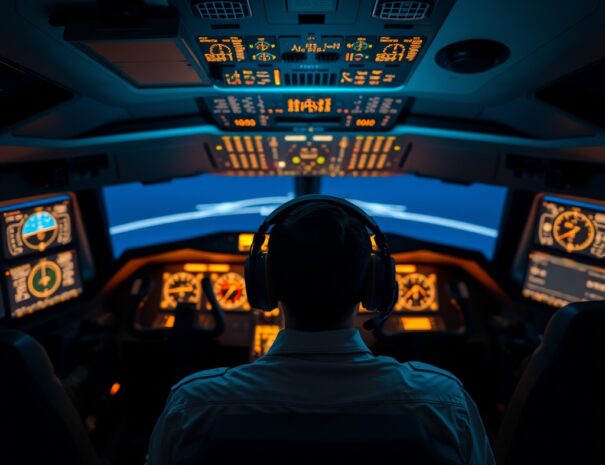
You’ve just finished an hour on the FNPT II and you’re left wondering: does that count as flight time? Can I use it toward the instrument ground time requirement for my IR training? And is it enough to save my recency for carrying passengers next week? Few areas of logbook-keeping cause as much confusion as crediting simulator time — not because the rules are arbitrary, but because four separate questions (device type, training course, recency, and how time gets recorded) tend to get blended into one. This article untangles the system under the currently applicable Part-FCL, and puts the ongoing 2026 EASA reform in its proper place: relevant, but not yet in force.
Four Letters, One System: FNPT, FTD, FFS, and BITD
The legal basis is Part-FCL, specifically the definitions in FCL.010 (Commission Regulation (EU) No 1178/2011, Annex I). Under the umbrella term FSTD (Flight Simulation Training Device) sit four device categories, distinguished mainly by how closely they replicate the aircraft:
- BITD (Basic Instrument Training Device): a ground-based device representing the pilot’s station of an aeroplane class, sometimes using screen-based instruments and spring-loaded controls. No visual system; used primarily in basic PPL training.
- FNPT (Flight and Navigation Procedures Trainer): represents the flight deck environment and system behaviour of a type or class closely enough that systems appear to function as they would in the aircraft. Levels FNPT I and FNPT II (plus FNPT III for helicopters). A visual or motion system is not mandatory.
- FTD (Flight Training Device): a full-size replica of a specific type’s instruments, equipment, panels, and controls, without a mandatory motion system — except for helicopter FTD levels 2 and 3, where a visual system is required.
- FFS (Full Flight Simulator): the highest-fidelity category, with a visual system for the out-of-window view and a force-cueing motion system. Qualification levels A through D, with level D also approved for zero-flight-time type-rating training.
The core principle: the higher the qualification level — from BITD through FNPT I, FNPT II/FTD, up to FFS level D — the more training credit it can generate against real flight time. Crucially, which level a given device actually holds isn’t a manufacturer’s marketing claim; it’s the outcome of a formal qualification process run by the competent authority.
How Much Simulator Time Counts Toward a Licence?
For training courses, Appendix 3 (integrated CPL/ATPL courses) and Appendices 6 and 7 (IR training) of Part-FCL set the ceilings on how much instrument ground time may be completed in an FSTD. These caps vary noticeably by licence and course type:
- Integrated ATP(A): of 95 hours of dual instruction, up to 55 hours may be instrument ground time, of which up to 40 hours may be in an FNPT II, FTD 2, or FFS — and within that, up to 10 hours in an FNPT I.
- Integrated CPL(A)/IR: of 80 hours of dual instruction, up to 40 hours of instrument ground time, with the same nesting (max. 40 h in FNPT II/FTD 2/FFS, of which max. 10 h in FNPT I).
- Integrated CPL(A) without IR: only up to 5 hours of instrument ground time in an FNPT I, FTD 2, FNPT II, or FFS, out of 10 hours of instrument instruction overall.
- Modular CPL(A) without IR: at least 25 hours of dual flight instruction, of which 10 hours instrument instruction, of which up to 5 hours may be instrument ground time.
- Standalone multi-engine IR(A) course: up to 40 hours of instrument ground time in an FNPT II, FTD 2, or FFS, of which up to 10 hours in an FNPT I. Holders of a Basic Instrument Rating (BIR) or a Basic Instrument Flight module certificate get up to 10 hours credited against the required instrument training time.
- Helicopters (integrated ATP(H)/IR, CPL(H)/IR): for the VFR portions, up to 30 hours in a helicopter FFS level C/D, or 25 hours in an FTD 2/3, or 20 hours in an FNPT II/III; for instrument instruction, up to 20 hours in an FFS/FTD 2,3/FNPT II,III, or 10 hours in at least a helicopter FNPT I or an aeroplane.
The takeaway: these figures are examples from specific courses, not a blanket “simulator time counts for X percent” rule. The ceiling that actually applies depends on the licence and rating type, and on whether the course is integrated or modular — check the exact appendix governing your course before planning.
Simulators for Recency and Currency: What’s Allowed — and What Isn’t
Outside initial training, the simulator also plays a role in maintaining currency:
- FCL.060, the 90-day rule: to act as pilot-in-command or co-pilot carrying passengers, or commercially, a pilot needs at least 3 take-offs, approaches, and landings on the relevant type or class within the preceding 90 days — as the sole manipulator of the controls, either in the real aircraft or in an FFS representing that type or class.
- FCL.625, IR revalidation: if IR revalidation is combined with revalidating a class or type rating, a proficiency check under Appendix 9 is required. For single-engine aeroplanes without a combined rating revalidation, that check may be conducted in an FNPT II or FFS representing the relevant class or type — but at least every second proficiency check for IR(A) revalidation must be carried out in a real aircraft.
The bottom line: simulators can partially substitute for real flying experience when it comes to recency, but never fully. In several places the rules deliberately enforce a rhythm of “one in the simulator, one in the real aircraft,” so that currency never becomes purely simulator-based.
Crediting Isn’t the Same as Logging: Three Points People Mix Up
This is where most day-to-day logbook confusion happens:
- FSTD time is not “flight time.” Under FCL.050 (Recording of flight time), time spent in an FSTD is recorded as its own category — synthetic training instruction time, or instrument ground time — not as flight time in the strict sense. Real aircraft flight time and simulator time must be recorded separately, even though both may count toward the training time for a licence or rating.
- Training credit doesn’t automatically mean logged flight time. Simulator time can be credited against the minimum hours for a licence, rating, or certificate without counting as flight time. Mixing the two categories is exactly what draws questions during an authority audit.
- The device’s qualification status is what matters. An FSTD must be formally qualified by the competent national authority or EASA, and hold a qualification certificate, before it can generate any creditable time. Unqualified devices — a basic cockpit mock-up for familiarisation, say — can be useful but generate no creditable time. A qualification certificate also says nothing about whether the device is approved for your specific programme — that’s the training ATO’s decision. EASA’s public FSTDIS register lists which devices are qualified across Europe.
The 2026 EASA Reform: What’s Changing — and What Still Applies Today
Since April 2026, a reform of the FSTD rules has been under way and it’s generating plenty of conversation — worth being precise about where things actually stand (checked 16 August 2026), because the reform is not yet applicable to day-to-day operations.
Commission Implementing Regulation (EU) 2026/781 was adopted on 8 April 2026, amending Regulation (EU) No 1178/2011 (Part-FCL) and Regulation (EU) No 965/2012 (Air Operations) with respect to flight simulation training device requirements. Alongside it, EASA published new certification specifications, CS-FSTD Issue 1, with associated AMC/GM (ED Decisions 2026/006/R, 2026/007/R, and 2026/008/R), which will replace CS-FSTD(A) Issue 2 and CS-FSTD(H). EASA communicated the reform publicly on 15 July 2026 via press release.
The central change is the so-called FSTD Capability Signature (FCS): it replaces the current system of fixed device types and levels (FNPT I/II, FTD 1/2/3, FFS A–D) with a capability-based description — devices will be assessed by their actual technical capability rather than a rigid type scheme. Alongside it comes a new “task-to-tool” methodology for type-rating and recurrent training, plus a regulatory pathway for newer technologies such as touchscreen cockpits and extended-reality systems.
What matters in practice: this only becomes applicable from 30 April 2028. Until then, the current Part-FCL system described above — its FNPT/FTD/FFS levels and familiar hour allowances — remains in force unchanged. Nothing needs to change in how you plan training or log time today; this is a coming, not-yet-effective change with a specific date attached. How the new FCS categories will translate the current Appendix 3/6/7 hour tables had not yet been published in detail in EASA’s public documents at the time of this research — check the updated AMC/GM texts again before relying on this for planning.
Common Mistakes and Misconceptions
- “Any simulator counts automatically.” Only an FSTD formally qualified by the authority, holding a qualification certificate, generates creditable time — a private cockpit mock-up used for familiarisation does not.
- “Simulator time is flight time.” Under FCL.050, FSTD time is its own recording category, not flight time in the strict sense, even though it counts toward training time.
- “A qualified device is automatically approved for my training programme.” Device qualification and its approval for a specific ATO programme are two separate questions.
- “The 2026 reform already applies.” Regulation (EU) 2026/781 and CS-FSTD Issue 1 only become applicable from 30 April 2028 — until then, the existing system remains authoritative.
- “A simulator fully replaces recency.” For IR revalidation, for instance, at least every second proficiency check must take place in a real aircraft.
Conclusion
Simulator time is a powerful, firmly regulated tool — but it isn’t a self-service counter. How much counts depends on the device’s qualification level, the specific training course, and the purpose (training, recency, or both), and it never fully replaces real flying experience. Anyone who keeps these four questions apart — device qualification, training course, recency rule, and recording category — makes noticeably safer decisions when planning training and keeping their logbook. And the upcoming EASA reform doesn’t change any of this for now: it doesn’t start applying until 2028.
In cloudlog.aero, aircraft and simulators are set up as separate entries with their device type under “Aircraft and Simulators.” The actual flight time — whether flown in a real aircraft or completed in a simulator — is recorded separately under “Flights,” linked to the corresponding aircraft or simulator entry. That separation between device master data and logged time mirrors the same distinction the regulations draw between device qualification and time crediting.
Sources
- Commission Regulation (EU) No 1178/2011, Annex I (Part-FCL), FCL.010 / FCL.050 / FCL.060 / FCL.625
- Commission Regulation (EU) No 1178/2011, Annex I (Part-FCL), Appendix 3
- EASA Easy Access Rules for Aircrew (Regulation (EU) No 1178/2011)
- EASA – Flight Simulation Training Devices (FSTD)
- EASA – Flight Simulation Training Devices (FSTD) FAQ
- EASA Qualified FSTDs Register (FSTDIS)
- EASA – EASA modernises flight simulation training devices’ rules (press release, 15 July 2026)
- EASA – Commission Implementing Regulation (EU) 2026/781
- EASA – CS-FSTD Issue 1
This article is provided for general information and reflects the sources consulted at the time of publication. It does not constitute legal advice or an authoritative statement by an aviation authority. The applicable laws, regulations, and the current guidance and decisions of the competent aviation authorities always take precedence.